
Tour review · TOUR REVIEWS
Bali Fruit Carving Class
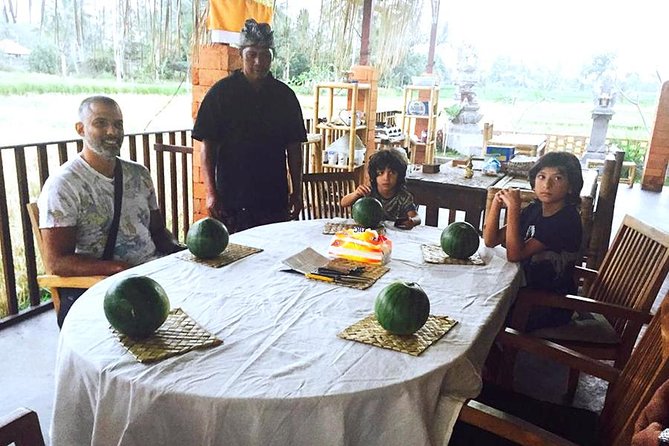
Carving fruit into art takes patience and fun. In Lodtunduh, Ubud, this hands-on class teaches you fruit carving techniques for flowers, animals, and even your name on fruit like watermelon and papaya. I especially like the small-group vibe, and I also enjoy the calming setting that makes the whole session feel slower and more creative. The one real drawback is also the honest one, you have to take your time and work carefully.
You meet at WS Art Studio Balinese Handicrafts in Lodtunduh at 10:00am for about 2 hours of instruction, practice, and a few tasty breaks. Everything you need is provided, and you’ll finish with a certificate you can keep as a souvenir.
Key Highlights You Should Know
- Small group, maximum 10 people, so the instructor can actually help as you carve
- All materials and equipment included, which makes the $39 price feel more fair
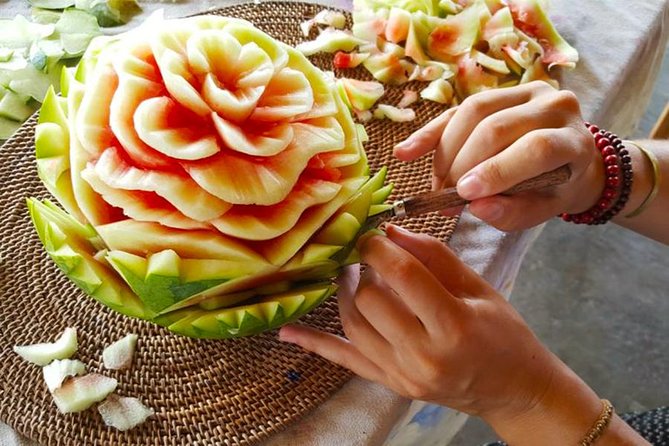
- Carve flowers, animals, and names on fruit like watermelon and papaya
- Two hours on the clock, with a guided rhythm that works for kids and adults
- Welcome drink, traditional snack, and a certificate, so it is not just a quick demo
Why Fruit Carving in Lodtunduh Feels More Like Craft Than Activity
Fruit carving is not about speed. It is about focus. One of the best parts of this class is that you do real technique work, not just watch a finished example and clap. You practice turning everyday produce into something that looks like art, using the same basic skills again and again.
Lodtunduh, near Ubud, gives the setting some calm. You are not trapped indoors in a crowded storefront. The class is designed to feel like a creative pause, with a studio atmosphere and time to settle into the method. One of the reviews you will see for this experience notes how soothing the outlook is during the morning session, and that matches the overall feel of the class.
The biggest value here is that the skill is portable. Once you learn the approach, you can apply it to other foods you already have access to back home. That is a lot more useful than a typical souvenir purchase that ends up in a drawer.
A few more Ubud tours and experiences worth a look



Price and What You Really Get for $39
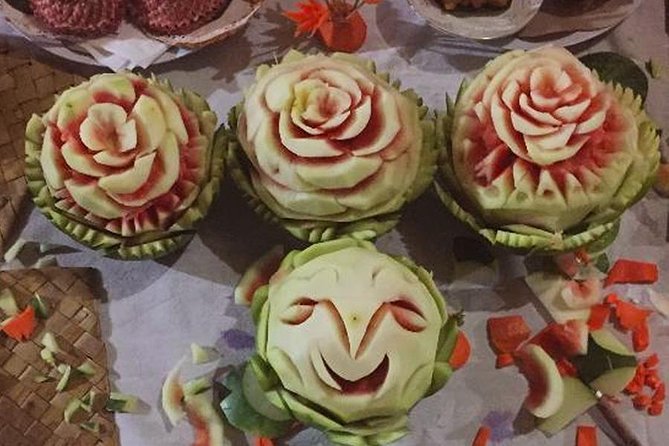
At $39 per person for about 2 hours, the key question is what you are paying for. Here, you are paying for instruction, time, and the materials. You do not show up empty-handed. The class provides the equipment and carving supplies, plus the fruit used in practice.
You also get a welcome drink and a traditional snack. That matters more than it sounds, because it turns the experience into a real activity you can pace, instead of something where you rush out hungry and tired. You finish with a certificate too, which gives you a concrete end point.
If you are weighing this against tours where you mostly get transport and photo stops, the math is simple. For the same budget range, this gives you a tangible skill and a handmade output, plus included food and a keepsake.
The 10:00am Flow, From Studio Welcome to Your Finished Carvings
The class starts at 10:00am at the WS Art Studio Balinese Handicrafts location in Lodtunduh. From there, the session is built around guided instruction plus hands-on practice. You are not expected to invent design ideas from scratch.
A typical rhythm looks like this:
1) You arrive and get set up at the studio meeting point.
2) Your instructor demonstrates the technique, starting with shapes that are more approachable, like carving flowers or animal forms.
3) You practice step-by-step, using the provided materials and equipment.
4) You carve your chosen style, which can include insects, animals, and name lettering on fruit.
5) You take a breather with the included welcome drink and traditional snack while the session keeps moving at an easy pace.
6) You receive your certificate as the finish line.
Because the group is limited to 10, you can usually get fixes when you hit trouble. That is the difference between a class and a show.
What You Learn: Flowers, Animals, Insects, and Names on Fruit
This class gives you multiple creative routes. You are shown how to carve a flower, and you can also learn animal designs. Another option is lettering, so you can carve your name on fruit like watermelon and papaya.
The practice menu also includes vegetables like carrots. You may work with different produce so you understand how texture and firmness affect the cuts. Carving carrots into flower-like shapes is a great way to learn how a slightly harder ingredient changes your blade angle and depth.
One of the most fun ideas is insects. The class framing mentions insects alongside animals, and that is exactly the kind of subject that rewards precision. Tiny details, like the placement of curves or points, are where the technique shows up.
The big takeaway is not the specific design. It is the method. Once you understand the basic cuts and how to build shape gradually, you can remix the approach into your own designs.
Equipment and Materials, and Why This Makes It Beginner-Friendly
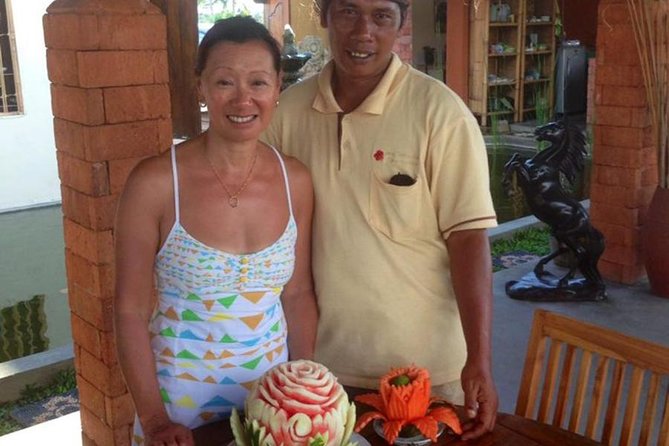
You might worry that fruit carving needs talent. It does not. The class is built for beginners, including kids.
Here is what helps most:
- Materials are provided, so you do not waste time figuring out what to bring
- Equipment is included, so you can focus on the technique
- The instructor guides you through patience and precision, not wild creativity on day one
Fruit carving does require careful control. The goal is clean lines and stable structure so the cut parts do not break off. But the class approach makes the learning curve manageable because you are practicing one skill at a time.
If you go in expecting to sprint, you may feel rushed. If you go in expecting a calm, careful craft session, you will feel right at home.





Small Group Size of 10: Why That Matters More Than the Location
Maximum group size is 10. That number is not trivia. It is the whole learning advantage.
In a big group, instructors can only give general tips. Here, the format supports individualized help. That means when you make a cut that is too shallow, too deep, or slightly off-center, you are more likely to get a quick correction before you waste your fruit.
It also changes the mood. You can ask questions without shouting. You can compare your progress with others without feeling like you are competing. For families, it keeps the session from getting chaotic.
The class also fits a wide age range, ages 4 to 65, which tells you the experience is designed to be flexible. Some kids will move fast. Some adults will slow down on purpose. Either way, the small-group format helps the instructor adjust to the pace at the table.
Snacks, Welcome Drinks, and the Calming Morning Break
This is not a “grab and go” tour. You get a welcome drink and a traditional snack. That matters because fruit carving can be surprisingly mentally demanding. Your hands concentrate, your eyes check alignment, and your brain learns a new process. A mid-session pause helps you reset.
Also, this morning time slot tends to feel gentler than later activities. You are doing something creative before the heat builds, and you can enjoy the calmer setting around Lodtunduh. One review highlights that the outlook feels calming, and the session is described like a relaxed morning spent learning.
If you are planning your day in Ubud, this class can slot in nicely. You get a satisfying activity early, then you are free to explore afterward without being wiped out.
Where You Meet in Lodtunduh, and Getting There Smoothly
You meet at WS Art Studio Balinese Handicrafts, with the address listed at C7X4+JFP, Lodtunduh, Ubud, Gianyar Regency, Bali 80571, Indonesia. The meeting point is described as easy to locate, and it is near public transportation.
Two practical tips that make this smoother:
- Aim to arrive a few minutes early so you are not setting up while everyone else starts carving.
- Plan to spend about 2 hours at the studio, since that is the class length (approx.).
Transport service is not included, so you will need to handle your own ride. If you are already in Ubud that day, this is usually the kind of activity you can reach without turning your afternoon into a logistics puzzle.
Your tour ends back at the meeting point, so you do not need to coordinate another pickup point.
Who This Is Best For, and Who Might Want a Different Tour
This class is for people who like hands-on learning and small-group settings. It is a strong fit if:
- you want a creative activity with a clear result
- you enjoy crafts, even if you think you are not “artsy”
- you travel as a family and want something calm and focused
- you like learning skills you can use again later
It is also worth it for couples and solo travelers because you are not competing for attention. The instructor can help you, and you have a shared experience with a manageable group size.
You might want to skip it if:
- you prefer big sightseeing days over quiet craft time
- you hate anything that asks for patience and precision
- you are looking for a pass-through tour where you do minimal work
One more reality check. The experience is non-refundable and cannot be changed for any reason. If your schedule in Bali is flexible, that matters. I would only book when you are confident you can make the 10:00am start.
The Value Verdict, Is This Class Worth $39?
For $39 and about 2 hours, the value is driven by three things: instruction, materials, and the outcome.
You get:
- carving equipment and materials
- a welcome drink and traditional snack
- a certificate
- a maximum group size of 10
That combination is rare in the “pay for an activity” world. Most classes charge for the demo, not the learning. Here, the structure supports practice.
If you leave with a sense of skill, not just photos, then you got your money’s worth.
Should You Book Bali Fruit Carving in Ubud?
Yes, if you want a calm, focused Bali experience that does not rely on a long travel day or a crowded schedule. This is a hands-on craft with a real learning curve, and it works for a wide age range.
Book it if you like the idea of turning fruit like watermelon and papaya into flowers, animals, insects, and even your name. Also book it if you want a small-group class where the instructor can actually help.
Skip it if you are short on patience, or if you want mostly passive sightseeing. Fruit carving is a work-your-hands kind of activity.
If your morning in Ubud is still open, this is one of the better ways to spend it.
FAQ
How long is the Bali Fruit Carving Class?
The class runs for about 2 hours (approx.).
Where is the meeting point?
You meet at WS Art Studio Balinese Handicrafts, C7X4+JFP, Lodtunduh, Ubud, Gianyar Regency, Bali 80571, Indonesia.
What time does the class start?
The start time is 10:00am.
What is included in the $39 price?
It includes a certificate, a welcome drink, a traditional snack, equipment, and materials.
Is transport service included?
No, transport service is not included.
What age range can participate?
The class is for ages 4 to 65.
What is the cancellation policy?
This experience is non-refundable and cannot be changed for any reason if you cancel or ask for an amendment.
More Workshops & Classes in Ubud

More Tour Reviews in Ubud



Not for you? Here's more nearby things to do in Ubud we have reviewed










Tour Reviews, compared.
 ★ 5.0All-Inclusive Ubud Private TourFrom $10014,344 reviews
 ★ 5.0Best of Ubud Full-Day Tour with Jungle SwingFrom $568,571 reviews
 ★ 5.0Monkey Forest, Jungle Swing, Rice Terrace, and Water TempleFrom $317,160 reviews
 ★ 5.0Best of Ubud 1-Day Private TourFrom $544,451 reviews
 ★ 4.4Bali: Ubud Palace Legong Dance Show TicketFrom $63,979 reviews
 ★ 5.0Uluwatu Sunset, Kecak Dance, and Dinner Jimbaran BeachFrom $353,681 reviews
 ★ 5.0Tanah Lot and North Bali Tour: Scenic JourneyFrom $1003,620 reviews
 ★ 5.0Body Massage Experience in Ubud Traditional SpaFrom $213,506 reviews
Browse the lists this tour appears in